
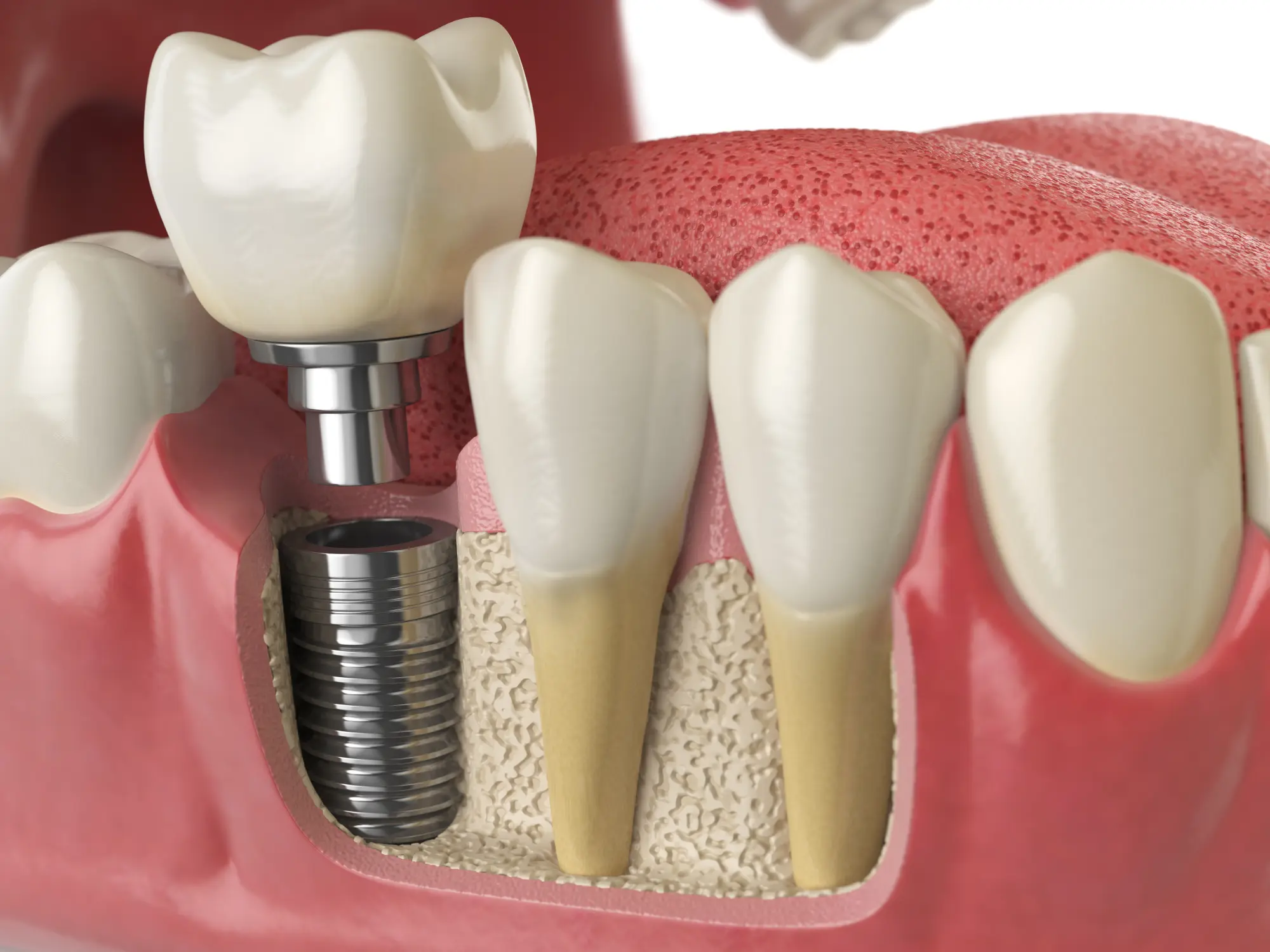
Dental implant surgery is the procedure used to place a small, biocompatible implant post into the jawbone. This post replaces the root of a missing tooth and creates a stable foundation for a future crown, bridge, or implant-supported denture.
At Diversey Dental Studio, Dr. Jacqueline Rodriguez performs dental implant surgery right here in our Lincoln Park office. From digital diagnostics and preparatory procedures to implant placement and follow-up care, your treatment is carefully planned around your health, anatomy, and long-term smile goals.


Every implant case is different, but understanding the basic steps can make the surgical process feel much more manageable. Before your procedure, our team will give you personalized instructions based on your treatment plan, health history, and comfort needs.
Successful dental implant surgery begins well before the day of placement. Dr. Rodriguez will use your exam and diagnostic images to evaluate the height, width, and quality of your jawbone. Digital scans or CBCT imaging may be used to see the area in three dimensions and identify nearby tooth roots, nerves, sinuses, and other important structures.
This information helps determine the ideal position, angle, depth, and size of the implant. It also allows Dr. Rodriguez to identify whether you need a tooth extraction, bone graft, sinus lift, or another preparatory treatment before surgery.
Before implant placement begins, the treatment area will be thoroughly numbed with local anesthesia. You may feel pressure or movement during the appointment, but you should not feel sharp pain.
Sedation may also be available when appropriate, particularly for patients who feel anxious about treatment or are undergoing a more involved procedure. Dr. Rodriguez will discuss your comfort options beforehand and let you know whether you need to arrange transportation or follow any special preoperative instructions.
When necessary, Dr. Rodriguez will make a small incision in the gum tissue to access the jawbone. The tissue is gently moved aside so the implant can be positioned according to the surgical plan.
Not every implant surgery follows exactly the same technique. The approach will depend on the location of the missing tooth, the amount of available bone, whether grafting is being performed, and the type of implant restoration planned.
A precisely sized channel is carefully created in the jawbone to receive the implant. Dr. Rodriguez will gradually prepare the site while protecting the surrounding bone and nearby anatomical structures.
The implant post is then inserted into the prepared space at the planned depth and angle. Creating strong initial stability is an important part of supporting the implant as the bone begins to heal around it.
Depending on your treatment plan, Dr. Rodriguez may attach a healing abutment that remains visible above the gumline. In other cases, a small cover screw may be placed and the implant may remain beneath the gum tissue during healing.
The right approach depends on factors such as implant stability, bone quality, the location of the implant, and whether any grafting was completed during the appointment.
If an incision was made, the gum tissue will be repositioned around or over the implant and secured with sutures. Some sutures dissolve on their own, while others may need to be removed during a follow-up visit.
Before you leave, our team will review how to care for the area, what to eat, how to manage discomfort, and which symptoms should prompt a call to our office.
A dental implant needs healthy gums and enough supportive bone to remain stable. Some patients can move directly into implant placement, while others need an additional procedure to prepare the area first.
Dr. Rodriguez will only recommend preparatory oral surgery when it is necessary to support a safer procedure and a more predictable long-term result.
.png)
.png)



The treatment area is thoroughly numbed with local anesthesia before surgery begins. Sedation may also be available when appropriate. Some tenderness, swelling, or soreness is normal afterward, but our team will provide instructions for managing your comfort during recovery.
You may need sutures if an incision is made in the gum tissue. Some sutures dissolve on their own, while others are removed during a follow-up visit. Dr. Rodriguez will explain which type was used and how to care for the area.
In some cases, an implant can be placed immediately after an extraction. This depends on the condition of the socket, available bone, presence of infection, and ability to achieve implant stability. Other patients benefit from allowing the site or a bone graft to heal before implant placement.
The length of your appointment depends on how many implants are being placed and whether an extraction, bone graft, or another procedure is being completed at the same time. We will provide a more accurate estimate after evaluating your needs and creating your surgical plan.
The implant generally needs time to integrate with the jawbone before it supports the final restoration. This process often takes three to six months, although your individual timeline may be shorter or longer.
In some cases, an implant can be placed immediately after an extraction. This depends on the condition of the socket, available bone, presence of infection, and ability to achieve implant stability. Other patients benefit from allowing the site or a bone graft to heal before implant placement.
"I like to treat patients as I would a family member or a friend." — Dr. Rodriguez
